
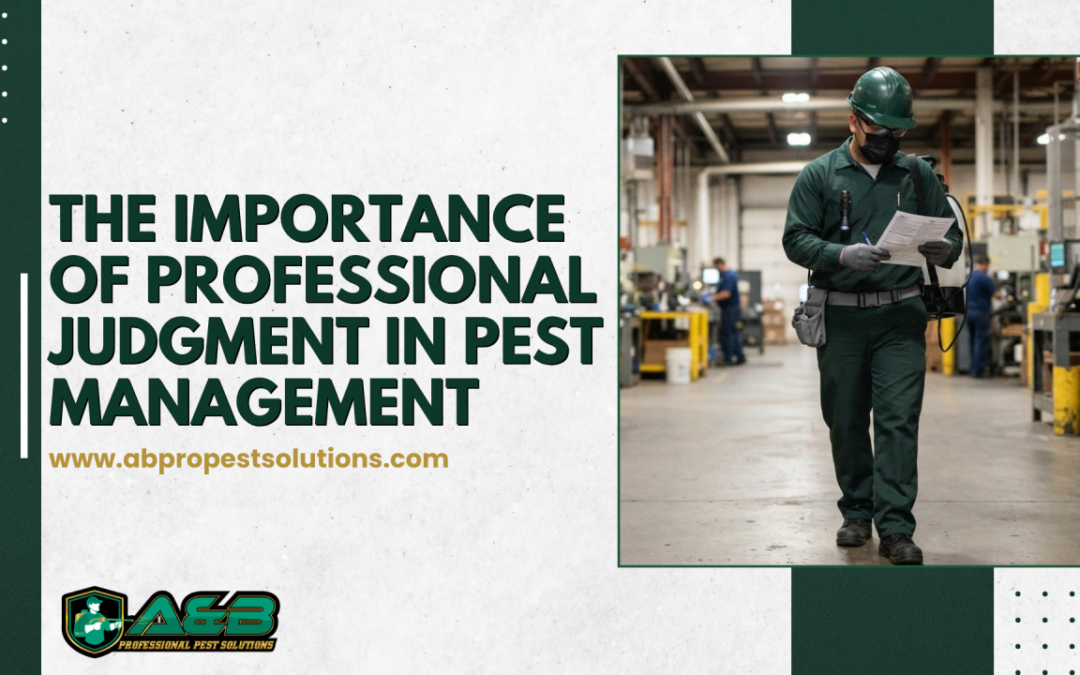
Effective pest management is not simply about identifying a pest and applying a treatment. The most important part of a successful pest management program is often something that cannot be seen in a photograph or measured by a piece of equipment: professional judgment.
Pest activity is influenced by many factors, including building design, environmental conditions, sanitation, moisture, food availability, pest behavior, structural defects, human activity, and previous treatments. Two properties may have the same pest species but require completely different approaches. This is why professional pest management goes beyond simply choosing a chemical or treatment method.
Pest Identification Is Only the Beginning
Correctly identifying the pest is essential, but identification alone does not explain why the infestation is occurring.
A professional technician evaluates the surrounding conditions to determine how the pest is entering, where it is getting food and water, where it is hiding, and what environmental factors are allowing it to survive.
For example, finding cockroaches in a food-service area may indicate more than a need for treatment. The technician may also identify food debris, leaking plumbing, poorly maintained drains, grease accumulation, gaps around utility lines, or inadequate waste management as contributing factors.
Treating the visible insects without addressing these conditions may provide temporary relief while allowing the underlying problem to continue.
Understanding the Cause Behind the Infestation
Professional judgment involves asking the right questions.
Where is the pest activity concentrated? What conditions are supporting the infestation? Is the activity increasing or decreasing? Are there structural entry points? Is moisture contributing to the problem? Could neighboring areas be serving as pest reservoirs? Has a previous treatment changed pest behavior or distribution?
These questions help technicians move from symptom control to source-based management.
A professional does not simply react to what is visible. They investigate the conditions that may be responsible for the pest activity.
Choosing the Right Treatment Requires Assessment
Not every pest problem should be handled using the same treatment.
Depending on the situation, an appropriate strategy may involve targeted application, baiting, monitoring devices, exclusion recommendations, sanitation improvements, moisture management, structural repairs, or a combination of several measures.
Professional judgment helps determine which approach is appropriate for the specific property.
For example, excessive pesticide application may not be the best solution when pest activity is primarily being driven by sanitation or structural issues. Likewise, simply sealing an entry point may not solve a problem when an established infestation is already present inside the structure.
The goal should be to use the right intervention, in the right location, at the right time, and at the appropriate intensity.
Technology Provides Information—Professionals Provide Interpretation
Modern pest management increasingly uses monitoring and detection technologies to improve inspection accuracy. Sensors, monitoring devices, moisture detection, thermal information, and other technologies can provide valuable clues that may not be obvious during a visual inspection.
However, technology does not replace professional expertise.
A reading or detection signal must be interpreted within the context of the building, environmental conditions, pest behavior, inspection findings, and treatment history. Professionals determine what the information means and what action should follow.
This distinction is particularly important when dealing with concealed pest activity, where a single indication does not automatically explain the size, location, or significance of an infestation.
Technology finds clues. Professional judgment turns those clues into informed decisions.
Pest Management Is a Process, Not a One-Time Event
Another important aspect of professional judgment is understanding that pest control should not always be viewed as a single treatment.
A successful program may require inspection, treatment, monitoring, evaluation, corrective recommendations, and follow-up.
After treatment, technicians need to determine whether pest activity has actually declined. If activity remains, the next step should not automatically be repeating the same treatment. The technician should reassess the situation and determine why the problem persists.
This creates a continuous improvement cycle:
Inspect → Identify → Assess → Treat → Monitor → Evaluate → Adjust
This approach is particularly valuable for commercial and industrial properties where pest prevention can affect food safety, regulatory compliance, employee welfare, customer confidence, and operational continuity.
Every Property Has Different Risk Factors
Professional judgment is also important because pest management must consider the unique characteristics of each property.
A warehouse may have loading bays, stored products, pallets, drainage systems, and multiple access points.
A restaurant may have food preparation areas, grease traps, drains, waste storage, and high levels of daily activity.
A residential property may have gardens, plumbing penetrations, roof spaces, wall voids, landscaping, and moisture-prone areas.
A healthcare facility may require particularly careful planning because pest management activities must be coordinated with hygiene requirements and sensitive operational areas.
The same treatment strategy cannot simply be copied from one property to another without considering these differences.
Knowing When Not to Treat Is Also Professional Judgment
Good pest management is not measured by how much product is applied.
There are situations where the appropriate professional recommendation may be to correct a contributing condition first, improve sanitation, repair a structural defect, remove a source of moisture, increase monitoring, or gather additional information before proceeding with a particular treatment.
This is an important distinction between professional pest management and treatment-only thinking.
The objective is not merely to eliminate pests temporarily. It is to reduce the conditions that allow pest populations to establish, reproduce, and return.
Documentation Strengthens Decision-Making
Professional pest management also relies on accurate documentation.
Inspection findings, pest activity, contributing factors, treatment areas, monitoring results, recommendations, and follow-up observations provide a record of what happened and how the situation changed over time.
For businesses, this documentation can be particularly valuable because it helps management teams identify recurring problems, track corrective actions, evaluate treatment effectiveness, and maintain a more structured pest management program.
Good records also allow future inspections to build on previous findings instead of starting from zero.
The Real Value of Experience
Experience allows pest management professionals to recognize patterns that may not be immediately obvious.
A technician may notice that recurring pest activity corresponds with moisture accumulation, seasonal weather changes, changes in waste handling, building modifications, nearby construction, or particular operational practices.
This experience does not replace evidence—it helps professionals interpret evidence more effectively.
The strongest pest management decisions combine observation, technical knowledge, inspection data, experience, and ongoing monitoring.
Professional Judgment Protects More Than the Property
Effective pest management protects more than walls, equipment, furniture, and stored materials.
For businesses, pest activity can affect product quality, food safety, reputation, customer confidence, employee comfort, and operational continuity. In homes, pest infestations can cause property damage, contamination concerns, and unnecessary stress.
Professional judgment helps ensure that pest management decisions are made with these broader risks in mind.
The Bottom Line
Pest control is not simply about applying a treatment when a pest is seen. It is about understanding why the pest is present, determining the level of risk, identifying contributing conditions, selecting an appropriate intervention, and verifying whether the solution is working.
That requires trained professionals who can interpret findings, recognize patterns, adapt strategies, and make decisions based on the specific conditions of each property.
At A&B Professional Pest Solutions Corp., effective pest management means looking beyond the pest itself. Our approach focuses on inspection, evidence-based assessment, targeted intervention, monitoring, and recommendations that address the conditions contributing to pest activity.
Because effective pest management doesn’t begin with spraying. It begins with knowing what you’re dealing with—and making the right professional decision.
To know more about A&B’s services, please visit the A&B’s website (www.abpestsolutions.com.ph) or Facebook Page (https://www.facebook.com/ABPestSolutions/) to know more about their services. A&B also disinfects workplaces or houses to kill COVID-19 Virus.
You may also contact: +63 905 496 4550 and +63 951 062 4830
A&B Professional Pest Solutions Corporation is located at the Ground Floor of Monterey Building at Genesis St., Centro de San Lorenzo, Santa Rosa, 4026 Laguna, Philippines