
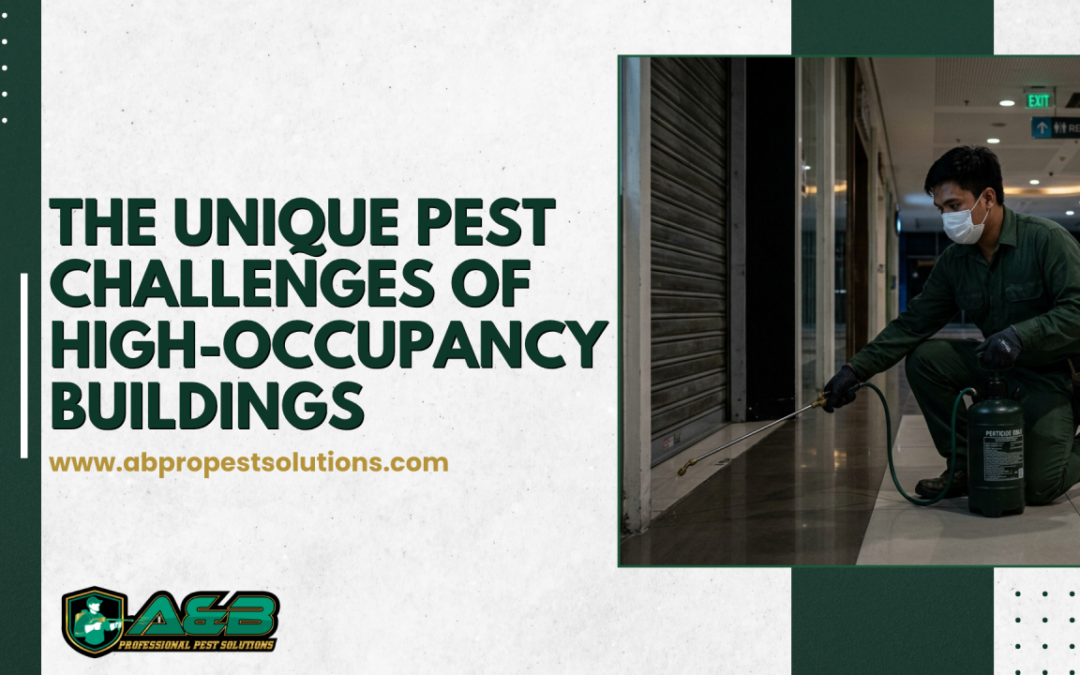
High-occupancy buildings—including offices, hotels, apartment complexes, schools, hospitals, shopping centers, restaurants, warehouses, and mixed-use developments—face pest management challenges that are very different from those of single-family homes or low-traffic properties.
The difference is simple: more people means more movement, more food, more waste, more moisture, more deliveries, and more opportunities for pests to enter and spread.
A pest problem in a high-occupancy facility is rarely confined to one room. Pest activity can move through shared walls, utility penetrations, plumbing systems, ceilings, service corridors, loading areas, storage spaces, and other interconnected areas. This makes professional inspection, monitoring, prevention, and coordinated intervention essential.
Why High-Occupancy Buildings Are More Vulnerable
High-occupancy properties constantly introduce conditions that can support pest activity.
Every day, people enter and leave the building, food and supplies are delivered, waste is generated, doors are opened repeatedly, and different areas experience changes in temperature and humidity. These activities create numerous opportunities for pests to find food, water, shelter, and entry points.
A building may appear clean and well-maintained while still having conditions that attract or support pests.
For example, a small amount of food residue beneath equipment, moisture around plumbing, an unsealed utility opening, or a damaged door seal may appear insignificant individually. However, when these conditions exist in a busy facility, they can become part of a larger pest-supporting environment.
1. Constant Human Movement Creates More Entry Opportunities
Frequent opening of doors is one of the biggest challenges in high-occupancy buildings.
Employees, residents, customers, contractors, visitors, delivery personnel, and maintenance teams may enter and exit hundreds or even thousands of times throughout the day. Each opening can create an opportunity for insects and other pests to enter.
Loading docks and receiving areas can be particularly vulnerable because deliveries may introduce pests through packaging, pallets, containers, vehicles, and incoming materials.
This means pest prevention cannot focus only on the building interior. Exterior conditions, receiving procedures, doors, docks, landscaping, and structural openings must also be evaluated.
2. Shared Spaces Allow Problems to Spread
In a low-occupancy property, pest activity may remain relatively localized. In a large facility, interconnected spaces can make pest movement much easier.
Pests may travel through:
- Wall voids
- Ceiling spaces
- Plumbing lines and pipe chases
- Electrical penetrations
- Utility openings
- Floor drains
- Service corridors
- Storage areas
- HVAC-related spaces
- Gaps around doors and windows
This creates an important distinction between where pests are seen and where the problem originates.
Seeing pest activity in one office, room, or workstation does not necessarily mean that area is the source. Professional pest management therefore requires technicians to investigate surrounding and connected areas rather than treating only the location where a pest was reported.
3. Food Availability Can Be Distributed Throughout the Property
High-occupancy buildings often have multiple potential food sources.
Restaurants, cafeterias, break rooms, vending areas, employee kitchens, food storage rooms, waste areas, and even individual workstations can contribute to pest pressure.
Food particles can accumulate in locations that are rarely noticed during routine cleaning, such as:
- Under refrigerators and equipment
- Behind cabinets
- Beneath shelving
- Around drains
- Under sinks
- Along wall-floor junctions
- Inside storage areas
- Around waste containers
Effective pest management therefore requires more than simply increasing the frequency of spraying. Sanitation and housekeeping conditions must be connected to pest activity findings.
4. Moisture Problems Can Become Hidden Pest Drivers
Water is another critical factor.
Leaks, condensation, clogged drains, plumbing defects, poorly ventilated areas, wet storage spaces, and water accumulation around exterior structures can create conditions favorable to various pests.
The challenge is that moisture problems are not always obvious.
A wall may look dry while moisture exists behind a surface. A plumbing leak may occur inside a cabinet or wall cavity. Condensation may repeatedly wet a particular area without creating obvious standing water.
This is why experienced technicians look beyond visible pest activity and consider moisture, drainage, ventilation, plumbing, and building conditions when determining why pest activity is occurring.
5. Waste Management Becomes More Critical as Occupancy Increases
More occupants generally means more waste.
Garbage rooms, dumpsters, waste collection points, recycling areas, grease traps, and disposal zones can become important pest-supporting locations when waste is not properly contained or managed.
Problems can develop when waste containers remain open, spills are not promptly cleaned, garbage accumulates, or waste storage areas are difficult to clean.
A strong pest management program should therefore evaluate not only the presence of pests but also how waste moves through the facility—from generation to temporary storage to final disposal.
6. Pest Problems Can Affect Multiple Occupants
One of the biggest risks in high-occupancy buildings is the potential impact of a pest issue on many people.
A pest sighting in an apartment building, hotel, healthcare facility, school, or workplace can quickly become a concern for residents, guests, employees, parents, customers, or management.
The response must therefore be carefully managed.
Unnecessary or poorly targeted pesticide applications can create additional concerns, particularly in environments where people are continuously present. Professional pest management emphasizes inspection, identification, targeted treatment, monitoring, documentation, and prevention rather than relying solely on routine chemical application.
7. Different Areas Require Different Strategies
A large facility should not be treated as one uniform environment.
A kitchen has different pest risks from an office. A loading dock has different vulnerabilities from a conference room. A garbage area has different conditions from a patient room, hotel room, warehouse, or administrative office.
This means pest management programs should be risk-based and location-specific.
Technicians should consider factors such as:
Food areas: sanitation, drains, food storage, grease, equipment, and waste.
Warehouses: incoming goods, pallets, packaging, storage practices, dock doors, and structural gaps.
Offices: break rooms, pantry areas, waste bins, plumbing points, and employee food practices.
Hotels and residential buildings: room turnover, guest movement, laundry areas, housekeeping practices, service corridors, and neighboring units.
Healthcare facilities: strict sanitation requirements, sensitive occupants, waste handling, food service areas, and the need for carefully controlled interventions.
Schools: cafeterias, waste areas, playgrounds, classrooms, drainage, and high daily occupancy.
A successful program recognizes these differences instead of applying the same treatment approach everywhere.
8. Monitoring Becomes More Important Than Occasional Treatment
In a high-occupancy building, waiting for someone to report a pest sighting can mean the problem has already developed.
Monitoring provides an opportunity to identify changes in pest activity before they become major issues.
Depending on the property and pest risk, monitoring may involve traps, insect monitoring devices, inspection points, bait stations, activity records, environmental observations, and routine inspections.
The information gathered can help identify:
- Areas with recurring activity
- Changes in pest pressure
- Potential entry points
- Sanitation concerns
- Moisture-related conditions
- Treatment effectiveness
- Locations requiring corrective action
The goal is not simply to eliminate what is visible. It is to understand patterns and prevent recurring activity.
9. Previous Treatments Can Complicate the Investigation
High-occupancy buildings may have a history of repeated pest treatments.
When different products, methods, or treatment schedules have been used over time, technicians need to understand what has already been done.
A previous treatment may have reduced visible activity without addressing the underlying cause. In other situations, pest behavior may change because of environmental modifications or repeated interventions.
Professional assessment should therefore consider treatment history alongside current observations.
This helps technicians determine whether the appropriate response is additional treatment, environmental correction, structural exclusion, enhanced monitoring, or a combination of several measures.
10. Communication Is Part of Pest Management
Managing pests in a high-occupancy property requires coordination.
Facility managers, maintenance personnel, housekeeping teams, security staff, food service employees, occupants, and pest management professionals may all have a role.
For example, a technician may identify a leaking pipe as a contributing factor, but pest control alone cannot permanently correct the plumbing problem. Maintenance intervention may be necessary.
Likewise, if food debris is repeatedly found in a particular area, housekeeping or operational changes may be required.
This is why good pest management is not simply a treatment service. It is a problem-solving process involving inspection findings, corrective actions, monitoring, communication, and follow-up.
Integrated Pest Management for High-Occupancy Buildings
The most effective approach is generally an Integrated Pest Management (IPM) strategy.
IPM focuses on understanding why pest activity occurs and combining multiple control measures rather than depending on chemical treatment alone.
A professional IPM program may include:
Inspection: Identifying pest activity, harborage areas, entry points, moisture conditions, sanitation issues, and structural vulnerabilities.
Identification: Determining the pest involved and understanding its behavior and biology.
Monitoring: Tracking activity over time to identify trends and determine whether control measures are working.
Exclusion: Addressing gaps, cracks, damaged screens, door gaps, utility penetrations, and other potential entry points.
Sanitation: Correcting food, waste, grease, and housekeeping conditions that support pest activity.
Environmental management: Addressing moisture, drainage, vegetation, clutter, and other contributing factors.
Targeted treatment: Applying appropriate control measures only where they are justified by inspection and monitoring findings.
Documentation: Recording observations, corrective recommendations, treatments, and follow-up findings.
This approach helps shift pest management from reactive treatment to proactive risk reduction.
Why Expertise Matters in High-Occupancy Properties
A pest problem in a large building cannot always be solved by treating the location where a pest was seen.
The real challenge is determining the connection between pest activity, building conditions, occupant behavior, environmental factors, and structural vulnerabilities.
Professional technicians must be able to interpret what they observe and determine what those observations mean.
A recurring pest sighting could indicate a nearby harborage area. Activity around a plumbing penetration could point toward moisture or an access route. Repeated activity near a receiving dock could indicate an entry pathway associated with deliveries. Activity in multiple connected areas could suggest movement through structural or service pathways.
The objective is to find the contributing factors, not simply respond to the symptoms.
Prevention Starts With Understanding the Building
Every high-occupancy property has its own pest risk profile.
Building design, occupancy levels, operating schedules, food handling, waste management, landscaping, drainage, maintenance practices, delivery procedures, and previous pest history all influence that profile.
That is why effective pest management should begin with a thorough assessment rather than assuming every property requires the same solution.
At A&B Professional Pest Solutions, our approach focuses on understanding the conditions behind pest activity and developing practical control strategies based on the property’s specific risks.
From inspection and monitoring to targeted treatments, environmental recommendations, structural observations, and follow-up assessment, the goal is to address pest problems at their source while supporting safer and more sustainable pest management.
Final Takeaway
High occupancy does not automatically create a pest problem—but it creates more opportunities for pest problems to develop, spread, and become difficult to manage.
The solution is not simply more frequent spraying.
It is better inspection, stronger monitoring, effective sanitation, structural prevention, environmental correction, targeted intervention, accurate documentation, and professional judgment.
When hundreds or thousands of people share the same building, pest management must be designed around the building—not just the pest sighting.
A&B Professional Pest Solutions — Smart. Safe. Sustainable Pest Management from the Ground Up.
To know more about A&B’s services, please visit the A&B’s website (www.abpestsolutions.com.ph) or Facebook Page (https://www.facebook.com/ABPestSolutions/) to know more about their services. A&B also disinfects workplaces or houses to kill COVID-19 Virus.
You may also contact: +63 905 496 4550 and +63 951 062 4830
A&B Professional Pest Solutions Corporation is located at the Ground Floor of Monterey Building at Genesis St., Centro de San Lorenzo, Santa Rosa, 4026 Laguna, Philippines