
Why Ignoring What You Don’t See Can Cost You Everything
In pest management, one of the most dangerous assumptions isn’t that pests are visible—it’s that they aren’t there at all.
The phrase “out of sight, out of mind” is deeply rooted in human psychology. It reflects our tendency to deprioritize threats that aren’t immediately visible or disruptive. While this mindset may be harmless in everyday situations, in pest management, it creates the perfect conditions for infestations to grow silently, systematically, and expensively.
Understanding the Psychology Behind the Problem
Humans are wired to respond to what they can see, hear, or feel. Immediate stimuli trigger action. Hidden risks, however, often fail to activate urgency.
In pest control, this translates into:
- Delayed inspections
- Reactive treatments instead of preventive strategies
- Overlooking early warning signs
- Assuming absence due to lack of visible activity
This psychological bias leads property owners and facility managers to underestimate the presence of pests—until the problem becomes impossible to ignore.
The Silent Nature of Pest Activity
Most pests are not designed to be seen. Their survival depends on remaining hidden.
Common hidden pest behaviors:
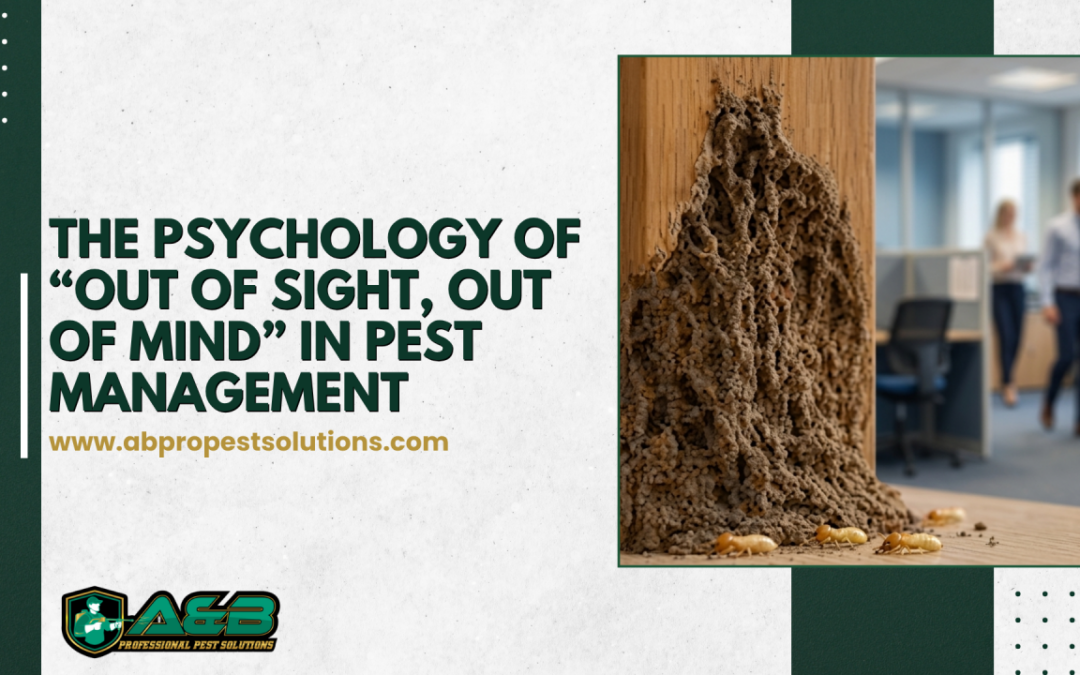
- Termites consume wood internally, leaving surfaces intact until structural damage is severe
- Rodents travel through walls, ceilings, and utility lines, avoiding open spaces
- Cockroaches thrive in dark, moist environments like drains, cracks, and behind equipment
- Ant colonies often exist deep within walls or underground
By the time visible signs appear—droppings, damage, or sightings—the infestation is already well-established.
The Real Cost of “Out of Sight, Out of Mind”
Ignoring hidden pest activity doesn’t eliminate the problem—it allows it to grow.
Consequences include:
1. Structural Damage
Termites and other wood-destroying organisms can compromise the integrity of buildings.
2. Health Risks
Pests carry bacteria, allergens, and pathogens that contaminate food and surfaces.
3. Operational Disruptions
In commercial and industrial environments, infestations can halt operations or trigger compliance violations.
4. Financial Losses
Early intervention is significantly less costly than major repairs and full-scale infestations.
Cognitive Bias in Decision-Making
This mindset is influenced by several psychological factors:
1. Normalcy Bias
People assume that things will continue as they always have—leading to underestimation of risks.
2. Optimism Bias
The belief that “it won’t happen to me” delays preventive action.
3. Attention Bias
Visible problems receive attention; hidden threats are ignored.
4. Delayed Consequence Effect
Since pest damage builds gradually, it lacks the urgency needed to prompt immediate action.
Why Traditional Pest Control Isn’t Enough
Conventional pest control methods often rely on:
- Scheduled inspections
- Visible signs of infestation
- Surface-level treatments
While these methods are important, they may not address the hidden layers of pest activity—where infestations actually begin.
Shifting from Reactive to Proactive Pest Management
To overcome the “out of sight, out of mind” mindset, pest management must evolve into a data-driven, proactive system.
Key strategies include:
1. Continuous Monitoring
Real-time tracking of pest activity—even in hidden areas
2. Data Analytics
Identifying patterns, hotspots, and risk zones before infestations escalate
3. Early Detection Systems
Pinpointing activity inside walls, floors, and inaccessible spaces
4. Predictive Prevention
Stopping infestations before they start—not after they spread
The Illusion of Cleanliness
A clean environment does not always mean a pest-free environment.
Many facilities fall into the trap of assuming: “We don’t see pests, so we don’t have a problem.”
In reality, pests are often present because environments provide:
- Shelter
- Food sources
- Moisture
- Entry points
Without proper monitoring, these conditions remain unnoticed—and exploited.
Changing the Mindset: Awareness is Prevention
Effective pest management begins with a shift in thinking:
👉 From visible problems → to invisible risks
👉 From reactive treatments → to preventive strategies
👉 From assumptions → to data-driven decisions
When you acknowledge that the most serious threats are often hidden, you begin to take control before damage occurs.
Final Thought
In pest management, what you don’t see can hurt you.
The absence of visible pests is not proof of safety—it may simply be a sign that the problem is still hidden.
Because by the time pests come into sight… they’ve already been there for far too long.
To know more about A&B’s services, please visit the A&B’s website (www.abpestsolutions.com.ph) or Facebook Page (https://www.facebook.com/ABPestSolutions/) to know more about their services. A&B also disinfects workplaces or houses to kill COVID-19 Virus.
You may also contact: +63 905 496 4550 and +63 951 062 4830
A&B Professional Pest Solutions Corporation is located at the Ground Floor of Monterey Building at Genesis St., Centro de San Lorenzo, Santa Rosa, 4026 Laguna, Philippines