
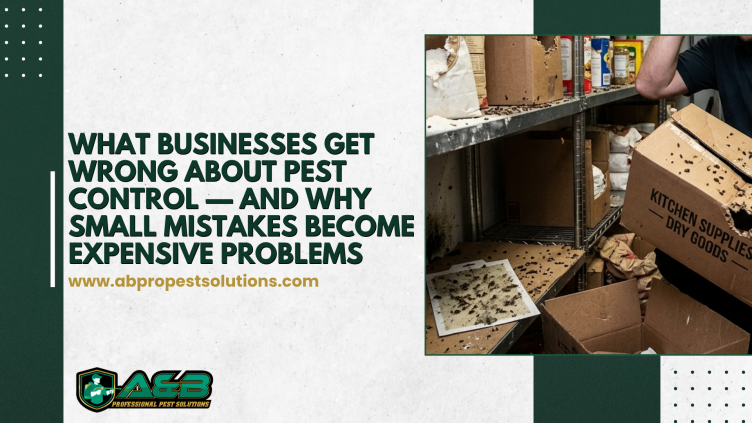
For many businesses, pest control is still treated as a reactive maintenance issue instead of a long-term operational protection strategy. The common mindset is simple:
“If we don’t see pests, we probably don’t have a problem.”
Unfortunately, that assumption is one of the biggest reasons infestations become costly, disruptive, and difficult to control.
Pests rarely become visible during the early stages of infestation. By the time rodents are seen inside warehouses, cockroaches appear in pantry areas, termites weaken structural wood, or flies begin circulating around food zones, the infestation has often been active for weeks or even months.
What many companies fail to realize is that small pest control mistakes gradually evolve into operational, financial, and reputational problems.
From food contamination risks and failed audits to damaged electrical systems and customer complaints, pest-related issues can impact nearly every area of business operations.
Understanding where businesses commonly go wrong is the first step toward preventing expensive consequences.
Mistake #1: Waiting Until There’s Visible Pest Activity
One of the most common mistakes businesses make is waiting for visible pest sightings before taking action.
By the time pests become noticeable, the infestation may already be established behind walls, ceilings, drainage systems, storage areas, or underground soil networks.
Rodents often travel through hidden pipe penetrations, ceiling voids, and drainage systems long before employees notice droppings or gnaw marks. Cockroaches thrive inside grease traps, electrical compartments, storage racks, and moisture-prone areas where routine cleaning may not fully reach. Termites can silently damage wooden structures for years without obvious external signs.
Visible pests are usually only the surface-level symptom of a much larger hidden problem.
Reactive treatments often cost significantly more because infestations are already widespread and require intensive corrective measures instead of simple preventive management.
Preventive pest control is almost always less disruptive and more affordable than emergency infestation response.
Mistake #2: Treating Pest Control as “Just Spraying”
Many businesses still believe pest control simply means applying chemicals whenever pests appear.
Modern professional pest management is far more comprehensive.
Effective pest control involves:
- Inspection and monitoring
- Entry-point identification
- Sanitation assessment
- Moisture management
- Structural risk evaluation
- Drainage inspection
- Rodent monitoring
- Termite detection
- Documentation and reporting
- Long-term prevention planning
Spraying alone does not solve the root cause of infestations.
If food debris remains inside drainage systems, garbage handling is inconsistent, wall gaps stay unsealed, or moisture accumulation continues, pests will eventually return regardless of how often chemicals are applied.
This is why Integrated Pest Management (IPM) has become the standard approach for responsible commercial pest control. IPM focuses on prevention, monitoring, environmental correction, and targeted treatments instead of relying solely on routine chemical application.
Businesses that ignore root-cause correction often end up trapped in a cycle of recurring infestations.
Mistake #3: Ignoring Small Structural Openings
Tiny gaps are often underestimated.
A small crack beneath a door, an unsealed pipe penetration, damaged drainage covers, or tiny wall openings can become major entry points for pests.
Rodents can squeeze through surprisingly small spaces. Cockroaches thrive in hidden crevices and wall voids. Flying insects enter through poorly screened openings and damaged seals.
Warehouses, restaurants, industrial facilities, and commercial kitchens are especially vulnerable because operational activity constantly creates opportunities for pest entry.
Many infestations persist not because treatments fail, but because structural vulnerabilities remain unresolved.
Pest control should always work together with facility maintenance.
Without exclusion measures, businesses unknowingly allow pests to continuously re-enter the property.
Mistake #4: Overlooking Drainage and Moisture Areas
Drainage systems are among the most overlooked pest-risk zones in commercial facilities.
Moisture attracts multiple pest species, including cockroaches, rodents, flies, mosquitoes, and termites.
Common high-risk areas include:
- Floor drains
- Grease traps
- Utility rooms
- Leaking pipes
- Clogged gutters
- Condensation-prone areas
- Standing water near buildings
- Poorly maintained septic and wastewater systems
Many infestations begin in hidden moisture zones long before pests spread into visible operational areas.
Termites are also strongly attracted to moisture-damaged wood and humid environments. Excess moisture around foundations and landscaping may increase subterranean termite activity near structures.
Routine inspections should prioritize these hidden high-risk areas rather than focusing only on visible spaces.
Mistake #5: Assuming One Treatment Solves Everything
Some businesses expect pest control to work instantly after a single service.
In reality, effective pest management requires continuous monitoring and follow-up.
Pest populations change depending on:
- Weather conditions
- Rainfall and flooding
- Seasonal breeding cycles
- Construction disturbances
- Food storage practices
- Waste management
- Operational changes
- Nearby environmental conditions
For example, construction activities may disturb underground termite colonies, forcing them to relocate toward nearby structures instead of eliminating them.
Rodent pressure may also increase during rainy seasons as rodents seek dry indoor shelter.
Without routine inspections and monitoring, early warning signs are easily missed.
Sustainable pest control depends on consistency, not one-time treatments.
Mistake #6: Underestimating the Financial Impact
Many businesses focus only on the direct cost of pest control services while overlooking the far greater financial risks caused by infestations.
The true cost of pest problems may include:
- Product contamination
- Inventory losses
- Structural damage
- Failed inspections or audits
- Customer complaints
- Business interruptions
- Reputation damage
- Equipment contamination
- Electrical wiring damage
- Legal liabilities
- Temporary closures
- Emergency treatment costs
For food businesses, hospitality establishments, warehouses, schools, healthcare facilities, and industrial plants, even a single pest incident can seriously damage customer confidence.
In highly regulated industries, pest-related findings may also affect compliance records and operational approvals.
Preventive pest management protects more than property — it protects operational continuity and business reputation.
Mistake #7: Relying Only on Visual Inspections
Visual inspections alone are no longer enough for many commercial properties.
Some infestations remain hidden inside walls, beneath flooring, within wooden structures, or underground.
Modern detection technologies such as termite monitoring systems and advanced inspection tools help identify hidden activity earlier without unnecessary structural damage.
For termite-prone properties, technologies like iTraker inspections can help detect hidden termite activity, moisture buildup, and possible risk zones before severe structural damage develops.
Early detection significantly reduces long-term repair costs.
Why Businesses Need a Preventive Pest Management Strategy
Professional pest management should function as an operational protection system — not just an emergency response service.
A preventive program helps businesses:
- Reduce infestation risks
- Protect facilities and inventory
- Improve sanitation standards
- Support regulatory compliance
- Minimize operational disruptions
- Reduce long-term treatment costs
- Protect customer trust and brand reputation
The most expensive pest problems are usually the ones businesses never saw coming.
Small oversights today can evolve into major operational problems tomorrow.
The businesses that experience fewer pest-related disruptions are usually the ones investing in consistent inspections, monitoring, sanitation improvements, structural maintenance, and preventive pest management before visible infestations occur.
Protect Your Business Before Small Problems Escalate
Pests do not disappear simply because they are out of sight.
Early detection, proper monitoring, sanitation improvements, and routine professional inspections remain the most effective ways to prevent expensive infestations and operational disruptions.
A proactive pest management program helps businesses stay protected, compliant, and operational year-round.
If your facility has not undergone a recent professional inspection, now may be the best time to identify hidden risks before they become costly problems.
To know more about A&B’s services, please visit the A&B’s website (www.abpestsolutions.com.ph) or Facebook Page (https://www.facebook.com/ABPestSolutions/) to know more about their services. A&B also disinfects workplaces or houses to kill COVID-19 Virus.
You may also contact: +63 905 496 4550 and +63 951 062 4830
A&B Professional Pest Solutions Corporation is located at the Ground Floor of Monterey Building at Genesis St., Centro de San Lorenzo, Santa Rosa, 4026 Laguna, Philippines